
Introduction
This post dives into a stored Cross-Site Scripting (XSS) technique I discovered while researching Fortinet’s endpoint protection solution. It builds on previous work, specifically part two of my series (CVE-2025-22859), where I detailed an httpd stored XSS vulnerability using a files with a predefined extensions.
I have already covered a small technique of achieving XSS on httpd when the attacker can’t control the file extension. However, unlike that prior method, which involved creating files with no name or only dots to bypass extension assignage, this new trick doesn’t depend on the absense of the X-Content-Type-Options: nosniff header. Complicating the other writeup, making these nice to add to our toolbox.
Details
The core of this technique lies in how Apache httpd’s mod_mime module determines a file’s Content-Type. Typically, mod_mime guesses the content type based on the file’s extension. If the X-Content-Type-Options: nosniff header is present, browsers are instructed not to “sniff” the content type and will default to text/plain when an Content-Type isn’t set. However, a closer look at the mod_mime documentation reveals an interesting behavior:
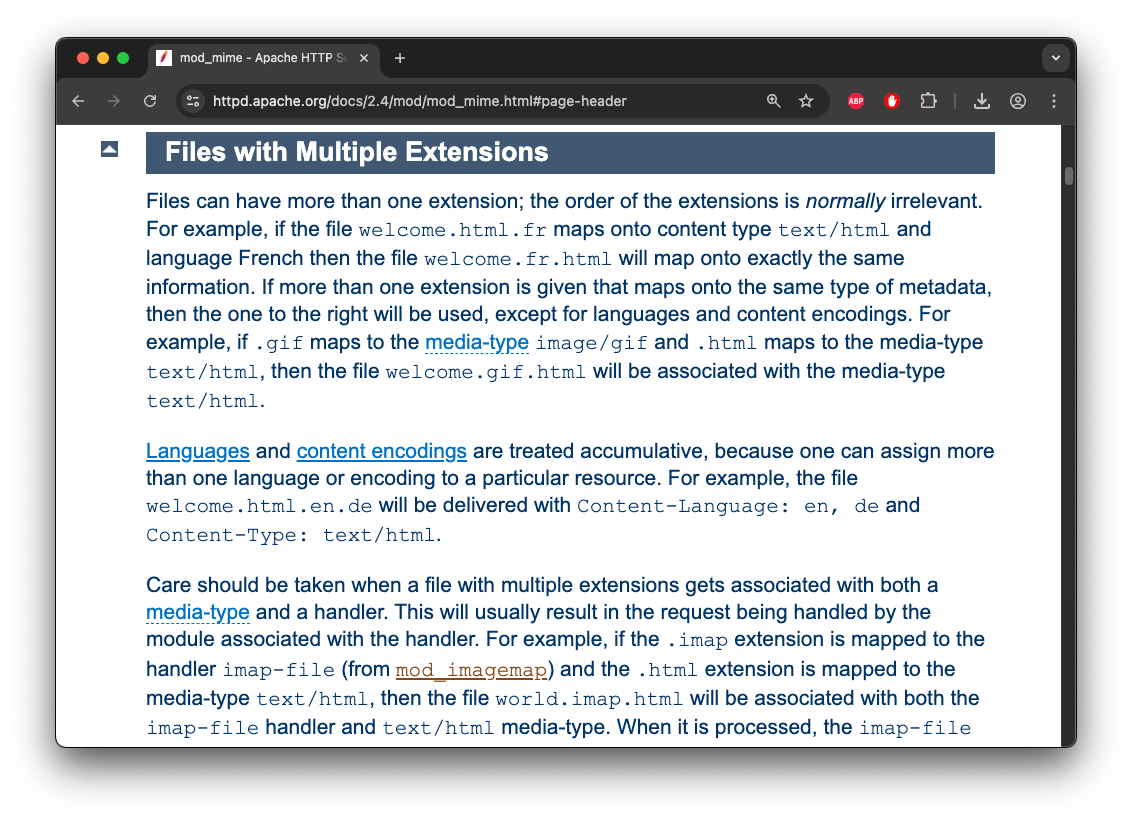
Files can have multiple extensions, with a priority given to the last one. For example, these file extensions will correspond to the following content-types:
| File Extension | mod_mime Content-Type |
|---|---|
| Filename.html | text/html |
| Filename.gif | image/gif |
| Filename.gif.html | text/html |
| Filename.unknown | |
| Filename.unknown.html | text/html |
| Filename.html.unknown | text/html |
The Attack Scenario
Armed with this knowledge, in a scenario where an attacker has the ability to upload a file, but can’t control the extension. If the extension doesn’t correlate to any content type in mod_mime (for example .abc), all the attacker would need to do is to add .html to the filename (filename.html.abc). When Apache serves this file, mod_mime will process the multiple extensions, recognize .html as the last and most significant one since .abc doesnt cererlate ot anything, and serve the file with Content-Type: text/html, resulting in stored XSS. This technique might also be used to bypass some server-side validation that only permits specific file types.